
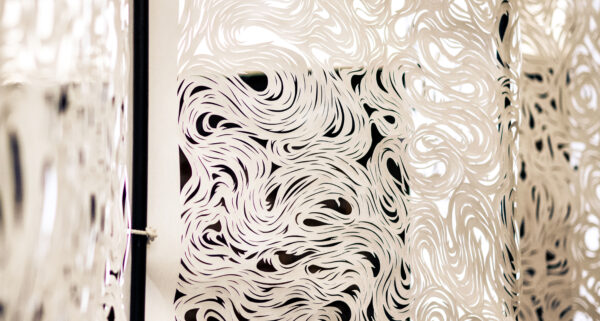
The earliest form of a Rock, Paper, Scissors-style game originated in ancient China before travelling to Japan, where it developed into the standardised form played today. From Japan, the game spread around the world in the early 1900s. Today, artist Jasmine Gardner has observed how the game is used to settle, often unserious, debates amongst friends and families.
‘We’re leaving the bar at 2am!’
‘No!… one more hour…’
‘Rock, paper, scissors?’
Interested in how the game has been adopted in British society, Gardner reimagines Rock, Paper, Scissors through objects from MEAA’s collection. She brings together jade and stone weights, brush holders, ceramics with papercut motifs, knives and blades, and her distinctive hand-cut paper works.
Her interpretation draws attention to smaller objects in the collection that reflect the physical materials of the game and connects them to her wider contemporary practice, which focuses on confronting micro-aggressive comments.
Inspired by the abstraction of traditional Chinese calligraphy, Gardner’s paper cuttings create a conversational bridge between traditional art forms and contemporary practice.
About the artist
Jasmine Su Juanyan Gardner, is a Manchester-based artist whose work primarily focuses on binding traditional Chinese art forms such as painting and paper cutting, with contemporary social issues surrounding her lived experience as an adoptee from the age of 8 months old. Themes from her lived experience are channelled through traditional Chinese artforms and mythology as a method to connect to her heritage.
The Staircase Series
The Staircase Series is a changing programme of exhibitions, displays and creative projects, bringing together artists, schools and partners to share new stories, ideas and perspectives throughout the year.
Planning your visit
The Staircase Series is located on the landing between the first and second floors, which is unfortunately not wheelchair accessible. We apologise for any inconvenience this may cause.
You can explore the displays through our digital guide on Bloomberg Connects, accessible from anywhere in the Museum. Physical copies of the guide and large-print labels are also available in the first and second floor galleries, both of which are accessible by lift.